

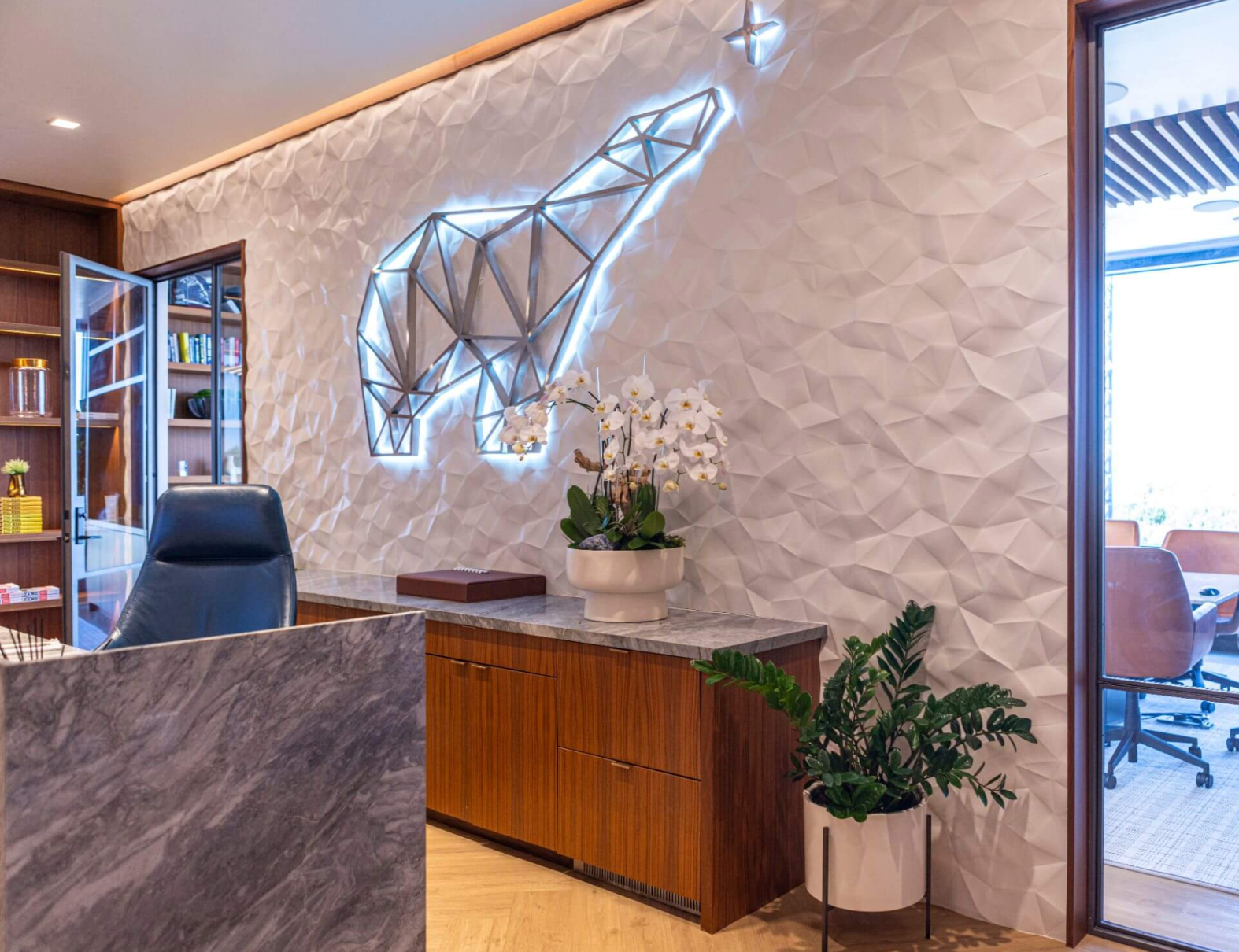
While biophilic design rests on our connection to nature, that doesn’t mean all the lush greenery you bring into your commercial space has to be real. Faux plants can be a great option to add life and freshness to your space.
And using artificial plants isn’t drawing a line in the sand. You can still use real plants, but by mixing in faux, you get more options.
Many of our clients don’t realize that many commercial spaces are already using faux and don’t know how to use both faux and real plants. If that’s you, this post will get you started in the basics of thinking about incorporating real and artificial plants into commercial design.
Designing with Real and Faux Plants for Exteriors
No matter what your business, your ambitions or your budget, designing with plants always starts with three core considerations: how is your space used? What is the aesthetic? And, what are the growing conditions?
How is your space used?
Real and faux plants can both provide privacy, shade, and barriers. They can both decorate entranceways and patios. They can both be used as tabletop plants (for example, in restaurants), window boxes, centerpieces, and more.
So knowing how your space is used, what is missing, and what could be improved will guide your exterior plant design.
Maybe you just need more ambiance and elegance poolside, where display pieces between hotel loungers will give a big lift. But if you need structure and purpose in your space, maybe container plants can help create paths and privacy between patio tables.

What is the aesthetic?
Both real and faux plants can look great, but not all varieties are going to give you the style you want. As we start a design with a new client, we take the time to get into your current designs, whether that’s architectural plans and moodboards or your ‘finished’ space. Aesthetics are also important for containers and styling, because plants aren’t the only element that creates a cohesive plant design.

What are the conditions?
Unless you are doing significant renovation or building from scratch, you can’t change the conditions of your exterior. That makes outdoor conditions a key difference-maker in your design choices.
Real plants need specific conditions to grow well, and may change throughout the seasons. They also require maintenance including watering, trimming, rotating and more. You simply may not get the look you desire if the plants you want aren’t suited to your plot’s features.
Faux plants can be placed anywhere regardless of conditions and aren’t going to change for the lifespan of the product. And with the sophisticated artificial plant offerings we have today, they can withstand harsh conditions and full sun without losing lustre.

Mixing real and faux plants outdoors
Crafting a design with both real and artificial plants gives you flexibility and continuity. You can choose from a wider mix of plants, and keep the same look through variable conditions, different seasons, and different locations.
Especially in a commercial setting, having a consistent design and aesthetic is something that communicates who you are to customers and employees, so this can help you make the most of your space. Mixing the two can also decrease your overall maintenance needs, while keeping the extra biophilic benefits real plants provide.
Designing with Real and Faux Plants for Interiors
Like with exterior plant designs, we also look at the use, aesthetic and conditions of your space when taking on interior plant designs.
How is your space used?
Typically in indoor spaces there are plenty of different reasons to use plants in one business space, especially in multi-story buildings or anywhere with different rooms.
For example, you may want plants for their attractiveness at reception, for their sound-absorbing and air-cleaning qualities in your office areas, and to provide interest and texture in a corporate lunchroom.

In retail, you are directing a customer’s eye to different parts of your store, for example towards a dressing room entrance or to a “new in” display, without overwhelming how merchandise looks. Using real and faux allows you to fulfill different needs in different spaces, or to provide continuity in the same space.
What is the aesthetic?
From lighting, fabrics, mixed flooring, different paint colors, to wallpaper and more, we take every interior décor choice into account when designing with plants.
If you are in a ‘finished’ space, we can enhance what you already have. If you are refreshing or decorating from scratch, we can work with your design team to find the right mix of plants, real and faux, that will give you the décor of your dreams.
Not being limited in real vs artificial plants means you can have a more thoughtfully curated space that can bring even very ambitious visions to fruition.
What are the conditions?
Especially in a variable climate like Texas, indoor temperature and humidity is often highly controlled in commercial spaces. There can also be a big variability of light indoors within one office, dealership, retail space or other business, as one part of your building might be south-facing and the other, north.

Traffic is something that is especially important to consider when choosing plants, as busy areas like hallways, reception, entryways, lobbies, and more can pose a problem for real plants. And, most challenging of all for real plants, commercial spaces often have rooms without windows, including bathrooms, meeting rooms, storage and break rooms, etc. This is one place where faux has an undeniable edge over real plants, and can be a very valuable addition to a design that otherwise features real greenery.
Mixing real and faux plants indoors
Designing with a blend of real and faux gives you opportunities to use real plants thoughtfully indoors where they will thrive and invest in faux as an option where they won’t.
It can help give you continuity throughout your space and mitigate unfavorable light conditions and challenging locations for plants like anywhere in proximity to an air conditioning vent. And it can lower your maintenance requirements vs using only real plants.
Thinking carefully about mixing plant types in your designs can mean you make the most of your budget, for example using faux for long-lasting greenery while supplementing with a rotating custom plant arrangement for the best of both worlds.

Busting Artificial Plant Myths
Faux always plants look fake and outdated
False. This is probably the biggest misconception we hear about faux botanicals. People imagine dusty silk arrangements and generic office décor from years ago, but the industry has evolved dramatically.
High-end faux botanicals today are incredibly realistic thanks to major advancements in materials, texture, color variation, and manufacturing. Many now closely mimic the movement, irregularity, and detailing of real foliage in a way that simply wasn’t possible even five years ago.
You can always tell when a plant is faux
False. When clients walk through our studio, one of the most common things they ask is, “Wait… what’s real and what’s faux?” Whether it’s orchids, succulents, cacti, or larger plant material, many people genuinely struggle to tell the difference.
When faux botanicals are thoughtfully sourced, professionally installed, and layered naturally into a space, they can feel incredibly believable. This holds true even when they’re placed next to live plants, meaning you can mix both in without people immediately spotting the difference.
Faux plants are only for people who don’t want maintenance
False. Maintenance is definitely part of the conversation, but the decision to use faux is often much more design-driven than people realize. Faux botanicals allow for consistency year-round, installation in low-light or difficult areas, dramatic scale without irrigation concerns, and more control over shape, color, fullness, and placement.
Faux also perform especially well in hospitality and commercial environments where lighting, HVAC systems, and heavy traffic can make live plants difficult to sustain. A lot of clients choose faux not because it’s easier, but because it best supports the overall design intent and long-term aesthetic of the space.
Faux plants don’t belong in luxury spaces
False. If you still believe this, know that many luxury hotels, restaurants, retail stores, and corporate environments now incorporate faux botanicals because they provide consistency and durability while still creating warmth, atmosphere, and visual impact.
Hospitality spaces especially have embraced high-end faux greenery for areas exposed to challenging lighting conditions, heavy traffic, or extreme temperatures. When used intentionally, faux botanicals can feel elevated, immersive, and completely aligned with luxury design.
I can’t get high-quality faux and real plants from the same supplier
False. While it is true that there are some places that only do real plants, many plant designers today, including Urban Spikes, are using and sourcing high-quality versions of both. We do this because it gives our clients the widest range of options and brings the best design possibilities forward.
Working with Urban Spikes
At Urban Spikes, we offer a variety of real and faux plants, as well as our specialty cut succulents, because we know that our clients benefit from both in many great designs. We go out of our way to get the best of everything, whether that’s containers and top dressing, preserved and decorative elements, real and faux plants.
We are capable of designing for commercial in- and exteriors, from offices to retail parks, healthcare settings to upscale hotels. And we give each project a completely bespoke design that makes a genuine difference to not just how your space feels but how it performs.
If you are in the Dallas-Fort Worth area and ready to explore your options for real, faux and everything in between, contact us today.


